Democracy and Autonomy – Speech

A speech by David Morris presented at The Other Economc Summit in Houston, Texas in July 1990, later published in Annals of Earth (Vol X, No.3, 1992).… Read More



A speech by David Morris presented at The Other Economc Summit in Houston, Texas in July 1990, later published in Annals of Earth (Vol X, No.3, 1992).… Read More

The garbage wars have begun. The well-publicized odyssey of the wandering garbage barge from Islip, Long Island in New York, is but the latest in a series of skirmishes that threaten the very political fabric of this country.… Read More
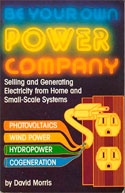
This book by David Morris (first published in 1983) was the first how-to book published after Congress ended the 100-year-old monopoly by utilities on the generation of power. The book examines the technical and economic aspects of four small scale power technologies (photovoltaics, wind power, hydropower and onsite cogeneration) and offers advice on how to negotiate a contract for sale of on-site power to local utilities.… Read More

Produced for the citizens of Saint Paul, Minnesota, this 1983 booklet by David Morris describes resource flows within the city and provides a look at local enterprises that serve as models of self-reliant economic development. Download Report:The Homegrown Economy: A Prescription for Saint Paul’s Future
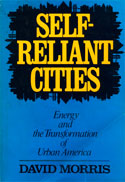
The first half of this book discusses the century-long struggle by cities to gain autonomy and authority from state governments and create their own planning and service delivery capacities. The second part describes the first urban-based localization movements. Given the relevance of the book to current localist efforts, we’ve written a new foreword that traces the local energy initiatives after the 75 percent plunge in oil prices after 1982 and the coming to power of a new administration hostile to renewable energy.… Read More





"From the hills of Seattle to the flatlands of Davis, from the industrial city of Hartford to the universty town of Madison, cities are beginning to redefine their role in our society," begins this important essay. For Morris the new role should should include inducing the widest distribution of productive capacity. New technologies make possible a more self-conscious and organic city. Local self-reliance becomes a strategy that embraces economic, environmental, and political goals. Morris argues that we have had far too much government and far too little governance. Government is bureaucratic. Governance is democratic. Communities can design their future. The new city-state emerge. … Read More
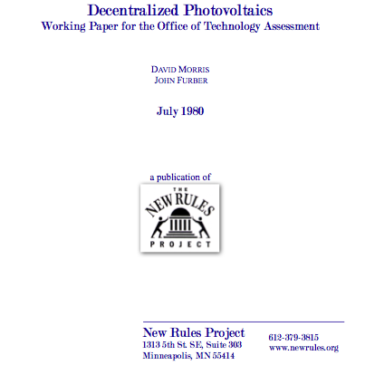
The Congressional Office of Technology Assessment invited the Institute for Local Self-Reliance to evaluate the comparative economics rooftop solar arrays and the solar powered satellites (SPS) proposed by NASA that would beam power generated in space back to earth. The report concluded, "If decentralized applications achieve the same array efficiency as those projected for SPS arrays, and if buildings are designed to maximize photovoltaic potential, the residential sector can meet all its energy demands from rooftop arrays, and have enough electricity left over to operate family vehicles, or to export into the grid system."… Read More
Thiswas the first study to track the flow of energy-related dollars through an urban economy and the impact on this flow from an aggressive energy efficiency and solar energy initiative. The study concluded that 85 cents of every energy dollar left the city, a far higher leakage than from any other household expenditure. The study also estimated the rooftop space available in DC for solar and the economic impact of energy efficiency.… Read More

Thisreport by David Morris was published (1975) shortly after the first plant manufacturing solar cells for terrestrial applications (Solarex) opened in suburban Washington, D.C. The report examined the embryonic PV industry, which was limited to remote, non-grid connected applications. The report proposed the creation of a government sponsored artificial market where demand would be increased at a steady pace in return for guarantees by companies that they would reduce the price of their product at an equally steady pace. The report also investigated the economies of scale of solar cells and concluded there were few, that rooftop arrays could generate its own power just as, or more efficiently then centralized solar power plants.


