John Bailey and Bill McKibben Discuss Community Solution to Global Warming




John Bailey and Bill McKibben Discuss Community Solutions to Global Warming on the Beyond Organics Radio Show
… Read More

John Bailey and Bill McKibben Discuss Community Solutions to Global Warming on the Beyond Organics Radio Show
… Read More
FOR IMMEDIATE RELEASE – February 13, 2006 Contact: David Morris or John Bailey, 612-276-3456 Minnesota’s Future Wind Energy Development An Opportunity to Nurture Local Ownership MINNEAPOLIS – “In the next five years, Minnesota is poised to become the community-owned wind energy capital of the nation,” says David Morris, co-author of a new report from the Minneapolis-based … Read More
In late January, Pacific Gas & Electric submitted an application to establish a three-year demonstration program termed the Climate Protection Tariff (CPT). The new tariffs would allow PG&E’s customer’s the option of paying a premium to completely negate the climate change impacts associated with their electricity and natural gas consumption.
This February 2006 policy brief by John Bailey and David Morris offers a brief overview of the existing renewable electricity mandates in Minnesota, and discusses the impact a proposed extension and expansion of these mandates might have. Last year, the Minnesota legislature debated a proposal to establish a new statewide renewable electricity mandate. That debate will undoubtedly continue this session.
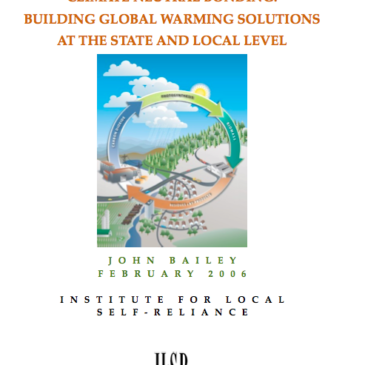
 This February 2006 policy brief by John Bailey provides background and analysis to support a state or local policy that would require construction projects funded with tax-exempt bonds to result in no net increases in greenhouse gases within the community. This brief proposes a strategy that can begin to allow us, as citizens and taxpayers, to make concrete our desire to live lightly on the earth. That strategy is to convince all tax exempt bond issuing agencies at the state and community level to adopt a climate neutralbonding policy.
According to an August 2005 Harris Poll 74 percent of people agreed that, "Protecting the environment is so important that requirements and standards cannot be too high, and continuing environmental improvements must be made regardless of cost."
This February 2006 paper by David Morris was adapted from a speech given at the Minnesota Ag Expo 2006. The paper provides a snapshot of today’s biofuels industry and a roadmap to ensure that local farmers see significant benefits from the expanding industry in the future.… Read More
The Distributed Energy Program from the Department of Energy’s (DOE) Office of Electricity Delivery and Energy Reliability (OE) is seeking public input for a study of the potential benefits of distributed generation required by section 1817 of the Energy Policy Act of 2005.
DOE invites interested parties to relate experiences, convey data, communicate results of case studies or analyses, or provide other information pertaining to the planning, installation, commissioning and operation of distributed energy systems.
Last week, a dozen cities, over 100 public power utilities, businesses and a host of national policy groups kicked off a nationwide campaign to urge automakers to accelerate development of plug-in hybrid vehicles. The “Plug-In Partners” campaign is hoping to demonstrate a large market potential so that automakers will start producing plug-in vehicles.
A recent column by Democratic Energy’s editor, John Bailey, outlines how potential building projects in the Governor’s $900 million bonding proposal in Minnesota should be constructed so that there are no net increase in greenhouse gas emissions.
New Minnesota Building Should Not Increase Greenhouse Gases – by John Bailey, published in St. Paul Pioneer Press, January 24,2006


