



Leander, Texas – Compost Amended Soil

On March 15th, 2007, the City of Leander, Texas passed and approved the Water Conservation Ordinance No. 07-018-00. Drought prone climate conditions and sharing water rights to/supply from the Colorado River with regional states warranted expanded water conservation and environmental landscaping policies; most notably, a minimum required percentage of organic content in landscaping activities.… Read More
Greeley, Colorado – Compost Amended Soil

The City of Greeley, Colorado has enforced water restrictions for over a century, but in the early 2000s decided to make the use of compost mandatory. By requiring a specific minimum amount of compost for all new lawn installations, the city increases the water retention of its soils and reduces the city’s water demand.… Read More

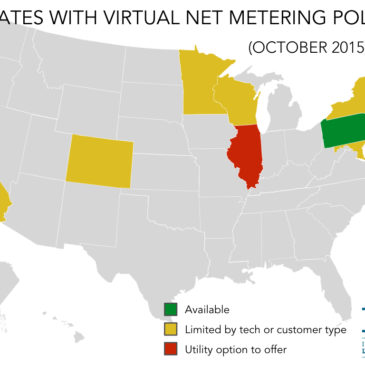
Updated: States Supporting Virtual Net Metering

(Last updated in 2016.) Virtual (or group or neighborhood) net metering (now also called “shared renewables”) allows utility customers to share the electricity output from a single power project, typically in proportion to their ownership of the shared system.… Read More

Local Purchasing Preferences

When making procurement decisions, many cities and states give preference to local businesses as a means to nurture small businesses and local economies. Some of these jurisdictions give a local preference only in the case of tie bids, but others give preference if a bid from a local business is within a certain percentage of the lowest non-local bid. Washington D.C., for example, by administrative practice gives a five percent preference to local firms.… Read More

Local Purchasing Preference — Phoenix

Phoenix is an example of a city that opted to start small. Rather than adopting a change in procurment policy, in 2012, the City of Phoenix altered its process for informal procurements—smaller contracts—instead. The city rolled out its Local Small Business Enterprise Program, which created a database to register small and local businesses. Further, the city said that LSBEs would get the first opportunity to submit quotes for all purchases of goods and services under $50,000.… Read More

Local Purchasing Preference — San Diego

Under the City of San Diego’s Small Local Business Enterprise Program, public works contracts valued at $1 million and above include a mandatory subcontractor participation requirement for certified SLBEs, contracts valued between $500,000 and $1 million have a 5 percent bid discount for SLBEs, and contracts valued between $250,000 and $500,000 are only open to certified SLBEs. Other forms of contracts, such as those for goods and services, contain similar elements.… Read More

Local Purchasing Preference — Montgomery County, Md.

In Montgomery County, Md., the Local Small Business Reserve Program designates certain solicitations only for LSBRP bidders, and aims to direct 20 percent of county contracts under $10 million to those firms. Under the program, “local” is defined as businesses that are either located only in the county, or businesses with locations both inside and outside of the county, but for which the county-based location accounts for over 50 percent of the total number of employees or over 50 percent of gross sales. The county has registered more than 1,220 local small businesses in its vendor system, and in 2012, it spent $83.7 million with LSBRP-certified businesses, or 16.7 percent of its total contract dollars.… Read More

Local Purchasing Preference — Cleveland

Cleveland has a variety of local procurement programs designed to drive contracting and purchasing to locally owned businesses. As a result of these developed policies, in 2014, the city spent 39 percent of its total $147 million in contracting with businesses that are either local and small, or local and minority- or female-owned.… Read More

Store Size Cap — Easthampton, MA

In June 2015, the City Council of Easthampton, a 16,000-person town in western Massachusetts, unanimously approved a zoning ordinance that caps new retail development at 50,000 square feet. The measure also reduces the acreage requirement for business development from five acres down to three, a move intended to attract smaller businesses. “In the last 10 years, … Read More

1 8 9 10 11 12 13 14 71