
Composting Resources – Search Results
Return to Composting home page
Page 17 of 26
Washington – Composting Rules
Washington has comprehensive composting regulations that facilitate composting by conditionally exempting several types of composting facilities – including those that process limited amounts of food scraps – from the requirement to obtain a permit. Washington also aims to protect the environment and human health by requiring composters to test for pathogens and adhere to specific performance-based standards.… Read More
Washington – Composting Rules
Washington has comprehensive composting regulations that facilitate composting by conditionally exempting several types of composting facilities – including those that process limited amounts of food scraps – from the requirement to obtain a permit. Washington also aims to protect the environment and human health by requiring composters to test for pathogens and adhere to specific performance-based standards. … Read More
Oregon – Composting Rules
Oregon’s composting regulations aim to facilitate composting while preventing public nuisance issues and any adverse environmental consequences from materials mismanagement. Oregon revised its composting regulations in 2009, as a means to both facilitate greater amounts of composting, as well as ensure new and existing facilities performed at the same level of quality standards.… Read More
California – Composting Rules
California’s regulations are written to encourage the production of high quality compost. Most composting operations are required to apply for a permit; however there are exemptions for some types of operations. For example, facilities that have less than 500 cubic yards of compost on-site, of which less than 10 percent is food scraps, are exempt from the requirement to obtain a permit.… Read More
California – Composting Rules
California has the largest number of organic farms in the US, and these operations frequently utilize compost products for its myriad benefits. As such, California is careful to both foster in-state production of compost, as well as regulate composting operations based on risk levels associated with facility type. Californian compost operations are categorized in tiers and most are required to apply for a permit; however there are exemptions for some types of operations.… Read More
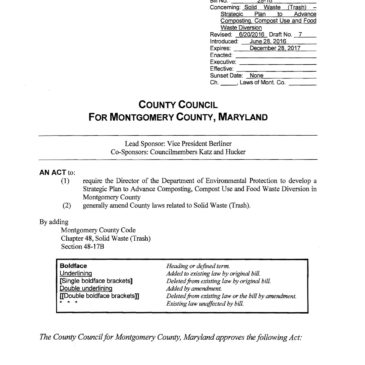
Montgomery Co. MD Bill Requires Distributed Composting




On June 28, 2016, Montgomery County Council (Maryland) Vice President, Roger Berliner, introduced legislation to require the development of a comprehensive composting and food recovery strategic plan. The bill might be the first in the country to stipulate a diverse and distributed plan that considers food rescue, backyard composting, community scale composting, on-site institutional and commercial composting, … Read More
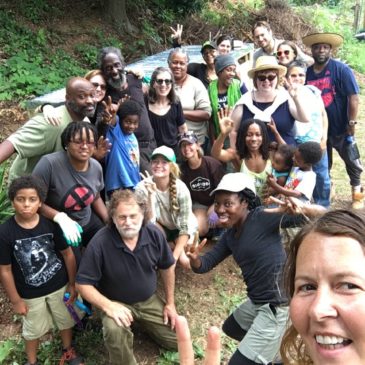
ILSR’s NSR Program Replicated in Atlanta, GA

ILSR is proud to introduce the Atlanta Community Compost Advocates! Atlanta-based Terra Nova Compost Collective partnered with ILSR and ECO City Farms to adapt their Neighborhood Soil Rebuilders (NSR) Composter Training Program for the diverse and charming City of Atlanta.… Read More
Policy Tools for Capacity Building
The Waste to Wealth program seeks to encourage a composting infrastructure that is locally distributed and possesses a diversity of scales, feedstock materials, and end-uses for compost products. For more information, see ILSR’s report on “The State of Composting in the US” for a national snapshot of composting policy and models to replicate.
California – Inter-Agency Cooperation
As of 2018, the state of California reported a 65 percent diversion rate for all materials and more than 140,000 green jobs in its recycling sector. This success is attributable to California’s 1989 Integrated Waste Management Act and the state’s more recent efforts to increase organics recycling through the California Department of Resources Recycling and Recovery (CalRecycle), a state agency that coordinates the state’s multiple waste and recycling management programs.… Read More
California – Local Infrastructure Planning
Seeking to further California’s waste diversion rate and thereby preserve landfill capacity for the future, the state enacted Assembly Bill 1826 on September 28, 2014. Also known as the Mandatory Commercial Organics Recycling (MORe) program, the bill requires commercial generators of organic waste to compost or anaerobically digest their food waste, landscape and other green waste, food-soiled paper, and nonhazardous wood waste. The law’s staggered dates of enforcement will allow adjustment time to develop greater capacity in California’s existing organic waste processing infrastructure.… Read More
California – Tax Exemptions
As of 2018, the state of California reported a 65 percent diversion rate for all materials and more than 140,000 green jobs in its recycling sector.[1] This success is attributable to California’s 1989 Integrated Waste Management Act[2] and the state’s more recent efforts to increase organics recycling through the California Department of Resources Recycling and Recovery (CalRecycle), … Read More
California – Mandatory Commercial Organics Recycling
Seeking to further California’s waste diversion rate and thereby preserve landfill capacity for the future, the state enacted Assembly Bill 1826 on September 28, 2014. Also known as the Mandatory Commercial Organics Recycling (MORe) program, the bill requires commercial generators of organic waste to compost or anaerobically digest their food waste, landscape and other green waste, food-soiled paper, and nonhazardous wood waste. The law’s staggered dates of enforcement will allow adjustment time to develop greater capacity in California’s existing organic waste processing infrastructure.… Read More

Compost Combats Desertification: Download New Poster

June 17th is World Day to Combat Desertification. In 1994, the United Nations declared June 17th the World Day to Combat Desertification and Drought to promote public awareness of the issue. While the UN focuses on those countries experiencing serious drought or desertification, particularly in Africa, the United States is not immune. “The dust storms and … Read More
Maine – Composting Permit Exemptions
In 2009, Maine adopted significant changes to its compost facility rules in an effort to advance the practice of composting. The revision of Maine’s composting rules was mandated by Chapter 139 of the 2007 Legislative Resolves, which directed the Departments of Agriculture and Environmental Protection to collaborate to 1) ease the regulatory burden on agricultural composting operations and 2) revise the volume and types of materials that may be composted without a permit from the state. … Read More
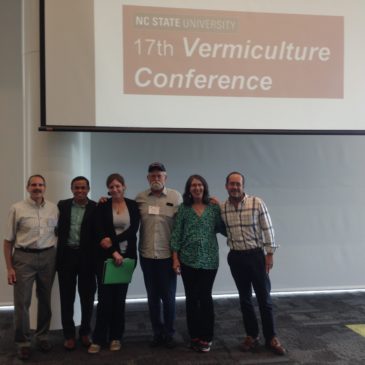
Lessons From the 2016 NCSU Vermiculture Conference

Worms are pretty amazing creatures! When used as a soil amendment, their waste has been shown to accelerate plant growth, suppress pests and diseases, and even increase levels of anti-oxidants in food. But vermiculture has other benefits that can contribute to a community’s self-reliance.… Read More