
Composting Resources – Search Results
Return to Composting home page
Page 18 of 26
Denver, Colorado – Compost Amended Soil
Denver is one of several communities to mandate the use of compost in disturbed soil and new landscaping as a means of improving the ability of soil to conserve and manage water. As water stress and pressures have become increasing concerns in western US states, simple, cost-effective solutions such as requiring a minimum amount of organic matter to … Read More
Food Scrap Recovery Policies
According to the US Environmental Protection Agency’s data on municipal solid waste generation and management, an estimated 52.4 percent of yard trimmings were “grasscycled” or composted in 2018, while only 6.1 percent of food scraps were composted. Policies that ban food scraps from landfills can have a tremendous and immediate effect on diverting organics from the … Read More
Ban on Yard Trimmings in Landfills
In addition to implementing yard waste reduction strategies, such as grasscycling, some jurisdictions have banned yard trimmings from landfills. Where such bans exist, public waste management authorities often provide residents the option of curbside collection if the yard debris is “source-separated” from other waste or public drop-off locations. Landfill bans, coupled with publicly provided alternatives and … Read More
Compost Procurement Policies
Government agencies, business, and institutions are developing environmental procurement guidelines and policies that require the purchase of compost to enhance their construction and/or landscaping operations. In addition, more and more of these entities are specifying that the compost be purchased locally, which minimizes transportation impacts, creates demand in the local market for a sustainable compost product, … Read More
Compost-Amended Soil Requirements
Incorporating compost into soils that are disturbed or damaged by human development (such as typical construction practices) has many benefits for the overall health of the soil ecosystem including: improved water retention, increased infiltration rates, greater binding ability, pH stabilization, and micronutrient enrichment. These micro-level soil benefits in turn, lead to significant community benefits on a … Read More
Performance-Based Composting Permit Regulations
Performance-based compost regulations describe standards to be met without imposing restrictions on the exact way to meet those standards. Several states in the Pacific Northwest (such as Washington and Oregon), as well as Ohio in the Midwest have implemented performance-based standards, thereby acknowledging that no one regulatory model is best for every facility. These rules foster … Read More
On-Farm Composting Rules and Permit Exemptions
Farmers have a vital role to play in producing and utilizing compost to restore depleted soils. Permit exemptions authorize compost operations on farms and smaller-scale facilities, such as community gardens, thus avoiding superfluous permitting requirements intended for larger, full-scale compost facilities. Because there are often significantly less risks or hazards associated with on-farm and small-scale composters, … Read More
NYC – Commercial Organics Recycling Mandate
New York City generates 1.8 million tons of commercial and residential organic waste, 95% of which ends up in landfills or incinerators both in and outside of New York state lines. In December 2013, NYC passed its Commercial Organic Waste law (Local Law 146), which took effect July 1, 2015. This law mandates specific large-scale generators to arrange for the recycling of their organic materials or employ department-approved methods to process the material themselves. The City has recently recommitted to organics recycling and is making efforts to expand curbside composting as part of its zero waste plans.… Read More
New York – Composting Rules
New York requires agricultural composters who accept any amount of food scraps from off-site to apply for a permit. In addition to the permit requirement, composters must adhere to specific performance standards including methods of vector and pathogen reduction. Some non-food materials, including animal manure and no more than 3,000 cubic yards of yard trimmings per year, may be conditionally exempt from the permit requirement.… Read More
Austin, TX – Universal Recycling Ordinance
In 2011, the City of Austin set a goal of a 75% diversion rate for solid waste by 2020 as part of its larger zero waste ambitions. In 2014, the city expanded its Universal Recycling Ordinance to include organics. Austin’s goals are based on a desire to mitigate methane emissions from landfills and promote economic development. In its Resource Recovery Master Plan, the city envisions providing incentives to encourage an economy in which the discards of one business can be the feedstocks of another business. A study prepared in 2008 for the city government by consultants estimated that a diversion economy could generate 1,800 jobs for Austin.… Read More
Wisconsin – Composting Rules
Wisconsin recently revised its composting regulations; the new rules became effective June 1, 2012. To ensure the quality of finished compost and minimize potential nuisances from materials mismanagement, the revisions require that composters use best management practices to curtail potential pathogens.… Read More
Rhode Island – Composting Rules
Rhode Island requires most small-scale composters to submit a registration to the state. Certain composting activities such as applying agricultural manures or composting agricultural by-products produced on-site may be conducted without a registration. In order for an agricultural composter to accept paper, yard trimmings, or food scraps from off-site they must receive approval from the Rhode Island Department of Environmental Management.… Read More
Rhode Island – Food Waste Recycling Requirements
In 2014 Rhode Island amended its Refuse Disposal laws to create a food waste ban in landfills and to promote the recycling of food residuals via composting and anaerobic digestion. Other approved methods include on-site composting or diversion for agricultural uses.… Read More
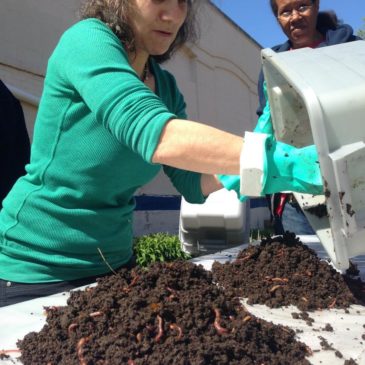
ILSR Leading Free Worm-Powered Composting Workshop As Part of DC Food Recovery Week of Action




ILSR’s Brenda Platt and Linda Bilsens are kicking of the DC Food Recovery Week of Action with a Worm-Powered Composting at Home Workshop, hosted by EW Stokes Community Freedom PCS on Saturday, May 14th. This workshop will cover benefits of vermicompost, and tips and tricks for proper worm-husbandry. … Read More
Connecticut – Organics Recycling Mandate
A 2009 waste characterization study of Connecticut’s waste stream found that food scraps are the single most common recyclable material (by weight) of the state’s disposed solid waste. In fact, almost one-third of the state’s annual contribution to landfills is made up of food scraps and other recoverable organics. These numbers prompted Connecticut to enact a recycling mandate for certain organic materials on January 1, 2014.… Read More