
Composting Resources – Search Results
Return to Composting home page
Page 25 of 26
Bye Bye Petro-Plastics, Hello Compostable Bioplastics?




ILSR launches its Sustainable Plastics Project, which is exploring the potential of bio-based and compostable plastics to substitute for harmful petroleum-based products and packaging. See ILSR’s article, “Crops Into Plastics: How emerging bioplastic technology could impact the waste stream” Waste Age (July 2006). In June 2006, the Oakland, California City Council passed an ordinance banning polystyrene … Read More
Community Record Setters
ILSR has been tracking and documenting community-wide recycling/composting programs for many years. Some of our reports on this subject are available online as PDF files. Others are available in hard copy format only.… Read More
The Paradigm Shift in NYC’s Solid Waste Management

Citizen Perseverance Pays Off; Still a Way to Go for a Zero Waste City By Neil Seldman and Kelly Lease Neil Seldman is Director of the Waste to Wealth Program and Kelly Lease is the program’s Senior Research Associate at ILSR. Seldman is a co-founder of the National Recycling Coalition and the GrassRoots Recycling Network. Please … Read More
Record Setting Recycling and Composting Programs
Twenty years ago, many solid waste planners thought no more than 15% to 20% of the municipal waste stream could be recycled. ILSR’s 1988 publication, Beyond 25%: Materials Recovery Age Comes of Age, shattered this myth. It featured 15 communities recycling 25% or more of their residential and commercial/institutional discards. Our 1991 report Beyond 40%: Record-Setting … Read More
Special Events
Recycling at Special Events by Kelly Lease 2000This case study, prepared for the California Integrated Waste Management Board, will help event organizers to reduce waste and local planners to establish programs and policies to encourage event recycling within their jurisdictions. It highlights efforts in California and elsewhere.
Office Building Models
Mini Trash Bins Help Office Settings Reduce Waste 50 Percent and More by Brenda Platt 2000Taking away people’s trash cans to reduce office waste is a novel concept-a concept that is spreading and resulting in high waste diversion. The heart of the system is making employees responsible for their trash by replacing their deskside trash can … Read More
Apartment Building Programs
Recycling in Multi-Family Dwellings by Kelly Lease 2000This case study, prepared for the California Integrated Waste Management Board, features programs and policies to encourage recycling in multi-family dwellings. It documents programs in Central Costa Contra, Davis, and Malibu (CA) as well as examples from across the U.S. Complex Recycling Issues: Strategies for Record-Setting Waste Reduction in … Read More
Food Scrap Recovery
Food Waste Recovery by Brenda Platt, 2000 This case study, prepared for the California Integrated Waste Management Board, features food recovery initiatives in San Francisco, Berkeley, and Santa Cruz County. It details collection systems for the commercial and institutional sector, collection of residential food discards with yard trimmings, and on-site composting of private sector food scraps. … Read More
Case Studies of Innovative Recycling Strategies Prepared for the California Integrated Waste Management Board
These five case studies of innovative recycling strategies were prepared for the California Integrated Waste Management Board (CIWMB) to help jurisdictions meet the state’s 50% diversion goal. Each case study details model programs, costs and benefits, tips for replication, contacts, and resources for more information. Food Waste Recovery by Brenda Platt This case study features food … Read More
ILSR’s U.S. EPA-Sponsored Waste Reduction Project
ILSR’s Waste Reduction Record-Setters project (1996-2000), funded under an U.S. EPA grant, identified and documented record-setting waste reduction programs in the public and private sectors. The project identified 100 communities and nearly 200 businesses, institutions, and other organizations reporting waste reduction — the combination of waste prevention and recycling — rates at 50 percent or higher. … Read More
DON’T THROW AWAY THAT FOOD: Strategies for Record-Setting Waste Reduction

The Institute for Local Self-Reliance’s Waste Reduction Record-Setters Project fosters development of exceptional waste reduction programs by documenting successful ones. These programs can be used as models for others implementing their own programs to reduce garbage. The Don’t Throw Away That Food information packet below is oriented toward commercial and institutional food discard generators, and highlights … Read More
Key Characteristics of Record-Setting Recycling Programs
Compost yard trimmings Only those programs with comprehensive composting of segregated organics have achieved very high levels of materials recovery. Target a wide range of materials For a community to recover a high percentage of its total waste, it must target a variety of materials. Targeting only two or three materials (for example, newspapers, bottles, cans) … Read More
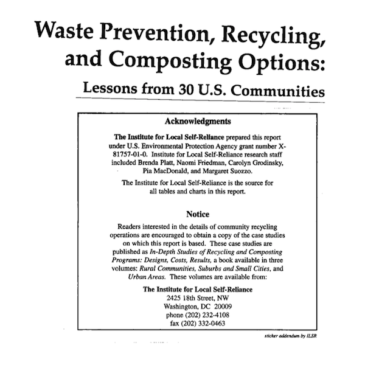
Waste Prevention, Recycling, and Composting Options: Lessons from 30 U.S. Communities

This report is a summary and analysis of the research conducted in In-Depth Studies of Recycling and Composting Programs: Designs, Costs, and Results. It looks at the operating experiences of 30 communities ranging from rural towns of 2,000 to cities of two million. It also offers nuts-and-bolts advice to communities wanting to strengthen their own programs. … Read More
Back Issues of ILSR’s Facts to Act On
Between 1990 and 1993, ILSR published its Facts to Act On series, 38 articles covering a wide range of topics on recycling, waste management, and grassroots organizing. The series was renewed between 2000 and 2002.… Read More
In-Depth Studies of Recycling and Composting Programs: Designs, Costs, Results, Volumes I, II, and III

This three-volume study is one of the most comprehensive compilations on community recycling programs. It details aspects of 30 U.S. community recycling programs, each selected for its geographic and demographic representation, high recovery rates, and/or notable innovations. Each volume includes model initiatives for source reduction, construction and demolition debris recovery, food waste recovery, and salvage/reuse operations. … Read More